
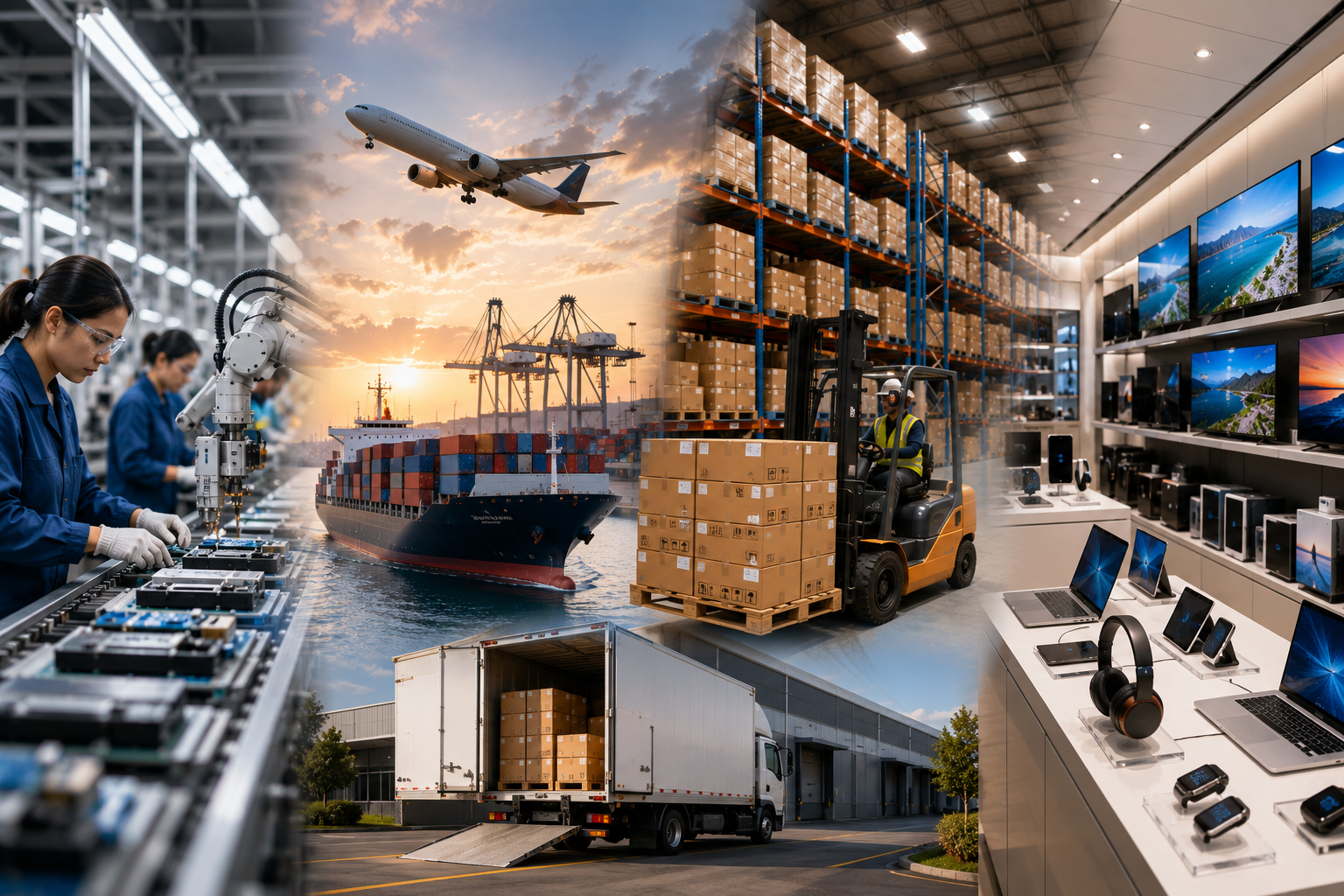
A product arriving at an Australian port is still months away from reaching a customer’s home, and the steps in between determine whether a brand can meet the delivery expectations major retailers and consumers now take for granted. National distribution Australia-wide involves customs clearance, compliance checks, warehousing, inventory allocation and freight across a continent where major population centres sit thousands of kilometres apart. Brands unfamiliar with this chain often underestimate both the cost and the coordination required to move stock reliably from a warehouse to a retail shelf or a customer’s front door.
Customs, Compliance and the First Mile
Before any stock can move toward a warehouse, it must clear Australian customs, which involves tariff classification, biosecurity checks where relevant, and confirmation that compliance documentation such as RCM certification is in order. Electronics and appliances containing lithium batteries face additional dangerous goods handling requirements at every stage of the supply chain, from ocean freight documentation through to last-mile courier acceptance. Delays at this stage are common for brands new to the Australian market, particularly when documentation has been prepared for a different country’s regulatory regime and does not translate directly to local requirements. Getting compliance and customs paperwork right before goods depart the origin country, rather than attempting to resolve it after arrival, is the single biggest factor in whether a shipment clears within days or sits held at the border for weeks. This first mile sets the pace for everything that follows, since retailers and marketplaces build their own commitments around expected stock arrival dates.
Warehousing and Where Stock Should Sit
Once cleared, stock needs to be held somewhere that supports efficient onward distribution, and this decision shapes delivery speed for the rest of the supply chain. Most national distribution Australia-wide strategies centre stock in or near Sydney or Melbourne, given their population density and central position relative to freight networks covering the eastern seaboard, while some categories justify secondary holding in Perth or Brisbane depending on customer concentration. Third-party logistics warehousing allows brands to avoid the capital cost of establishing their own facility while still gaining professional inventory management, pick-and-pack capability and integration with retailer and marketplace order systems. Inventory accuracy at this stage matters enormously, since a warehouse that cannot reliably confirm stock levels in real time creates downstream problems for every channel drawing from it, from retailer purchase orders to Amazon FBA replenishment to direct-to-consumer website orders. Brands should also plan warehouse capacity around seasonal peaks, since Christmas and EOFY trading can require several times the baseline stock holding of quieter months.
Order Fulfilment Across Multiple Channels
A brand distributing nationally rarely sells through a single channel, and the fulfilment operation needs to serve retail purchase orders, marketplace orders and direct-to-consumer sales simultaneously without stock allocation conflicts between them. Retail purchase orders typically arrive in bulk with specific delivery windows and compliance requirements around packaging and labelling, while marketplace and direct orders require individual pick, pack and courier dispatch, often within same-day or next-day service levels. Coordinating national order fulfilment across these channels from a single, accurately tracked stock pool avoids the common problem of overselling on one channel while stock sits unused in another. It also allows a brand to respond quickly when a retailer places an urgent replenishment order ahead of a promotional period, since fulfilment infrastructure built for multiple channel types is generally more flexible than a warehouse set up to service only one sales channel.
Freight Networks and the Last Mile Challenge
Australia’s geography makes last-mile delivery genuinely difficult in a way that many international brands underestimate before entering the market. Freight between capital cities is well served by established carriers, but delivery to regional and remote areas can add several days and meaningfully higher cost per parcel, which needs to be factored into both pricing and customer delivery expectations. Retailers and marketplaces increasingly measure suppliers against on-time and in-full delivery metrics, and consistently missing these benchmarks affects future order volumes regardless of product performance. Brands should also plan for the reverse logistics side of national distribution, since returns and warranty claims need a defined process that does not require every faulty unit to be shipped back to an overseas manufacturer for assessment. A distribution partner with established freight relationships across major carriers can secure better rates and more predictable transit times than most brands could negotiate independently at launch volumes.
Scaling Distribution as Sales Volume Grows
The distribution setup that works for a brand’s first hundred orders a month rarely suits its five-thousandth, and national distribution Australia-wide needs to be built with growth in mind from the outset. As order volume increases, the operational cost of manual processes such as spreadsheet-based inventory tracking or ad hoc courier bookings grows faster than revenue, eroding margin at exactly the point a brand should be becoming more profitable per unit. Scaling successfully generally requires system integration between inventory management, retailer EDI ordering and marketplace platforms, so that stock allocation and order status update automatically rather than through manual reconciliation. Brands that plan for this scaling early, working with a distribution and fulfilment partner capable of handling both current volume and reasonable growth projections, avoid the disruptive process of migrating to new infrastructure mid-growth, which often coincides with exactly the periods when reliable fulfilment matters most to retail partners.
Frequently Asked Questions
What does national distribution Australia-wide actually involve?
It covers customs clearance, compliance checks, warehousing, inventory management and freight coordination needed to move stock from a port of entry to retail shelves, marketplaces and direct-to-consumer customers across the country.
Where should stock be warehoused for national distribution?
Most brands centre stock near Sydney or Melbourne given population density and freight network access, with some categories justifying secondary warehousing in Perth or Brisbane depending on customer concentration and delivery speed needs.
Why is last-mile delivery a challenge in Australia?
Australia’s population is spread across a large geography, so delivery to regional and remote areas takes longer and costs more per parcel, which needs to be planned into pricing and customer expectations.
How do retailers measure a distributor’s fulfilment performance?
Retailers typically track on-time and in-full delivery rates, along with order accuracy and responsiveness to replenishment requests, and consistently poor performance can reduce future order volumes regardless of product quality.
Can one distribution partner handle retail, marketplace and direct orders?
Yes, an integrated fulfilment operation can serve retail purchase orders, marketplace platforms and direct-to-consumer sales from a single accurately tracked stock pool, avoiding overselling and improving flexibility across all channels.
When should a brand upgrade its distribution infrastructure?
Before manual processes like spreadsheet inventory tracking become a bottleneck, typically as order volume scales beyond what one person can manage reliably, since disruptive mid-growth migrations often coincide with critical retail periods.
