
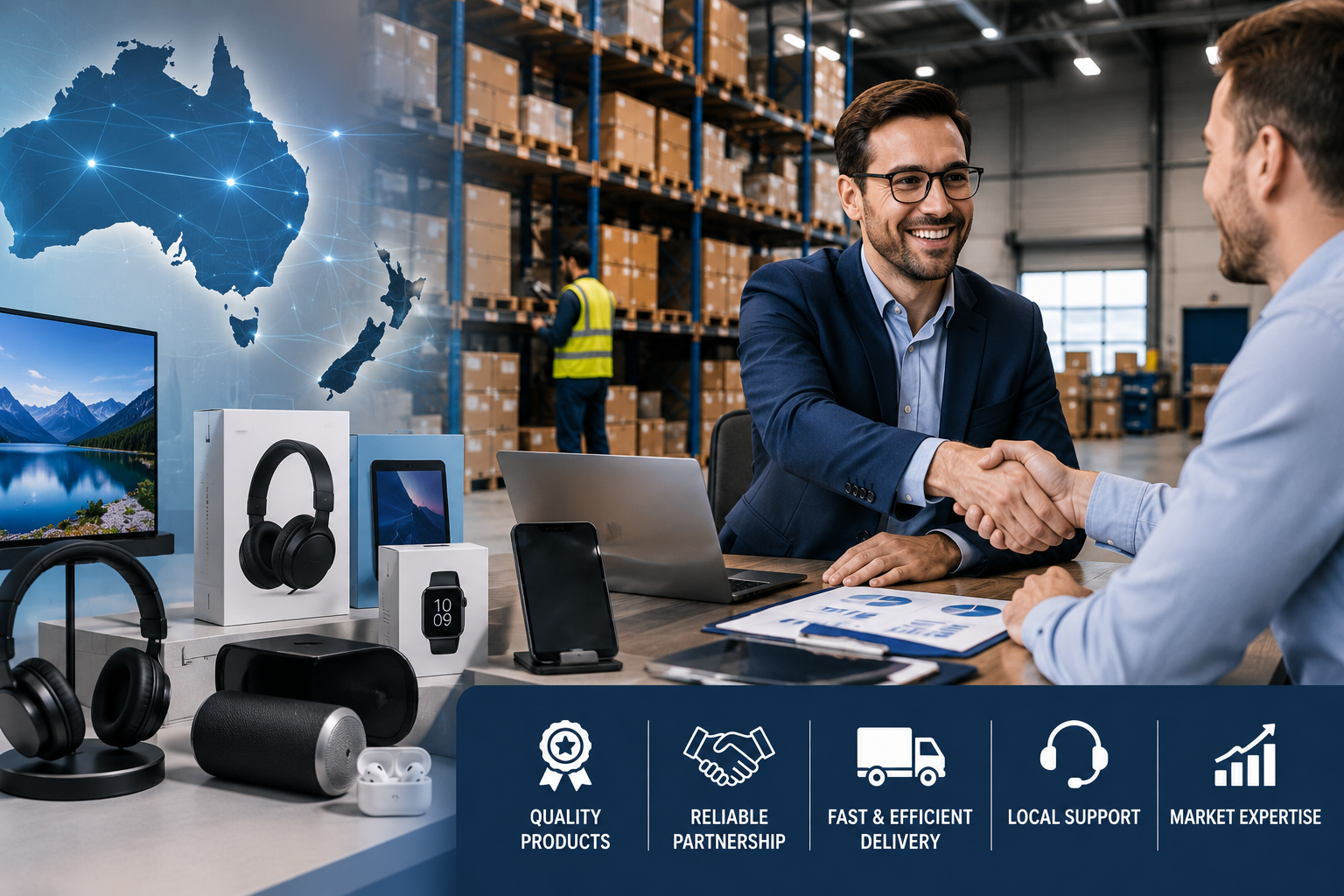
In a consumer electronics market worth roughly USD 28 billion and still growing, the difference between a product that thrives in Australia and New Zealand and one that quietly disappears often comes down to a single decision: who distributes it. Distribution has evolved well beyond warehousing and freight. In a mature, fragmented, and increasingly demanding market, the right distributor functions as a strategic partner — shaping demand, protecting margins, and giving a brand genuine reach across the region.
Whether you are a brand planning to enter the market or a retailer deciding where to source stock, the criteria below will help you tell a true growth partner apart from a passive supplier.
1. Genuine Omnichannel Reach
The single most important question to ask is how broadly a distributor can actually place your products. The days when supplying a few large retail chains was enough are over. Today’s market spans national electronics specialists, independent retailers, online marketplaces, and direct-to-consumer platforms — and consumers move fluidly between them.
A strong distributor manages product placement and visibility across hundreds of physical store locations and multiple online platforms at the same time. Bricks-and-mortar specialists still dominate high-involvement purchases where customers want to see and compare products in person, but e-commerce continues to capture share and now generates billions in annual electronics revenue. Look for a partner with a proven presence across both, not one that leans on a single channel and hopes the rest follows.
2. Data-Driven Forecasting and Inventory Management
In a mature market where volume growth is modest, efficiency is everything. Order too much and capital is trapped in unsold stock; order too little and sales are lost when demand spikes. The distributors who consistently get this right are those using historical data, seasonal patterns, and market trends to forecast demand accurately.
Ask a prospective partner how they forecast, how they track inventory, and whether stock levels are visible in real time. Real-time inventory tracking means retailers are never left guessing about availability, and accurate forecasting means fewer stockouts and less dead stock. This operational discipline is often the difference between a product that sells through smoothly and one that stalls on the shelf.
3. Warehousing and Fulfilment Across the Tasman
Serving Australia and New Zealand efficiently is a logistical challenge in its own right. The strongest distributors operate warehousing on both sides of the Tasman, enabling faster fulfilment and more consistent service in each country rather than shipping everything from a single location.
Beyond storage, look closely at fulfilment capability: efficient picking, packing, and dispatch that can handle both full retail shipments to national chains and single units going directly to online customers. As e-commerce grows, the ability to fulfil direct-to-consumer orders reliably — and to integrate with a brand’s online platforms for automated order processing — has become a baseline expectation, not a bonus.
4. Regulatory Compliance and Warranty Support
This is where inexperience becomes costly. Consumer electronics sold in Australia must meet electrical safety standards and carry the appropriate regulatory markings. Regulated products such as televisions, air conditioners, and refrigerators must also meet minimum energy performance standards before sale, and from March 2026 connected smart home devices face mandatory cybersecurity standards as well.
A capable distributor ensures every product satisfies these requirements before it reaches a shelf. Just as important is warranty support: authorised distributors supply products with full local manufacturer warranties, unlike parallel imports that may carry international warranties not serviced locally. For retailers, this is a genuine trust and repeat-business advantage — the ability to offer proper after-sales support depends directly on sourcing through an authorised, compliant partner.
5. Marketing, Content, and Brand Activation
Getting a product onto a shelf is not the same as getting it sold, and this is where the modern distributor’s role has expanded most. The partners winning market share now offer value-added services that once sat with brands or agencies.
Look for a distributor that runs targeted promotional campaigns timed around key sales periods, produces regular video and social content, and works with key opinion leaders and micro-influencers to build awareness faster than traditional advertising allows. Effective customer acquisition — through ads, EDM, marketplaces, reviews, and online chat — should be woven into their distribution proposition. In categories like smart home, where products need explanation and demonstration, this activation capability is what converts consumer interest into actual sales.
6. Sales Team Training and Product Knowledge
Connected and higher-value electronics are more complex to sell than a simple plug-and-play appliance. A shopper considering a smart security system or a connected appliance often needs guidance, and that guidance comes from retail floor staff.
The best distributors invest in training the sales teams across their distribution channels, ensuring staff are equipped with current product knowledge and selling techniques. This delivers consistent messaging and a better consumer experience wherever a product is sold. When evaluating a partner, ask how they support the people who ultimately close the sale — because a well-informed salesperson is one of the most underrated assets in the entire chain.
7. Resilience in a Shifting Economy
Finally, consider how a distributor performs when conditions get tough. Early 2026 saw the electronics and home appliance retail sector face elevated interest rates and softer consumer confidence, putting pressure on sales and margins. In exactly these conditions, distribution excellence matters most: retailers cannot afford the wrong stock, and brands cannot afford poor visibility.
A partner who combines deep market insight with disciplined inventory management and strong marketing support gives your business a buffer against volatility. Ask how a prospective distributor has navigated soft markets before, and how they help partners protect sell-through when consumers become cautious.
Making the Decision
Choosing a consumer electronics distributor in Australia and New Zealand is not about finding the cheapest logistics provider. It is about finding a partner who can carry your product across a fragmented omnichannel market, forecast and manage inventory with precision, guarantee compliance and warranty support, activate demand through marketing and content, and equip the people selling your products to do it well.
The businesses that will thrive over the coming decade are those that treat distribution as a strategic engine rather than a cost centre. Weigh a prospective partner against each of these criteria, and you will be far better placed to choose one that drives reach, visibility, and sustained growth — rather than one that simply moves boxes.
