
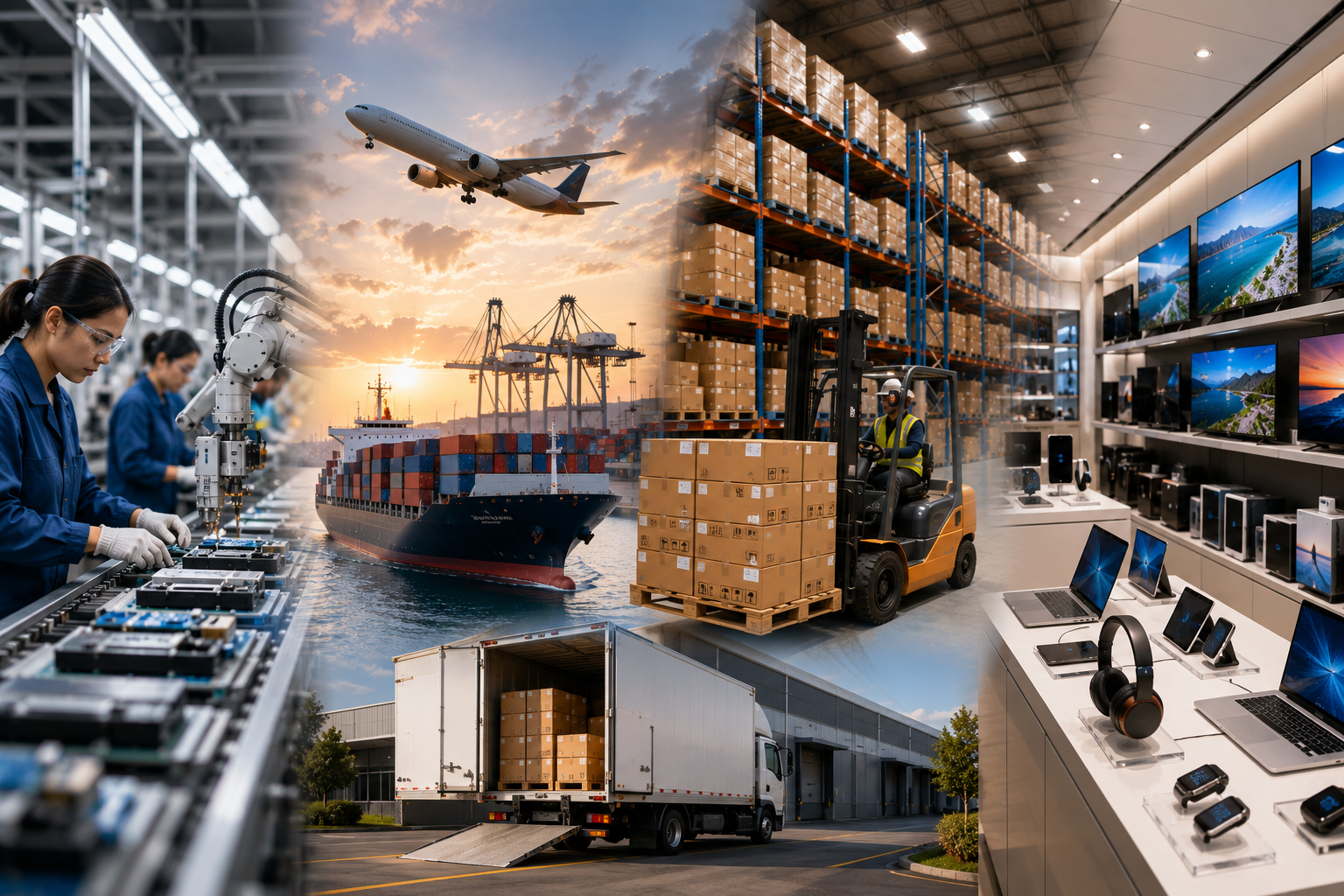
When an Australian shopper picks a robot vacuum or a smart speaker off a shelf, the transaction takes seconds. Behind that moment sits a supply chain that may have taken months to orchestrate, spanning international manufacturing, freight, customs clearance, warehousing, compliance testing, and channel management across a market of more than 500 retail touchpoints. In a consumer electronics market worth roughly USD 28 billion, the distribution network is the invisible infrastructure that makes it all work — and understanding it explains a great deal about why some products succeed in Australia while others never gain traction.
This is a look inside that network: the stages a product passes through on its way from a manufacturer overseas to a shelf in an Australian store or a customer’s online basket.
Stage 1: From Manufacturer to Importer
Most consumer electronics sold in Australia are manufactured overseas, so the journey almost always begins with an importer or distributor placing an order with a brand or factory. This is a more strategic decision than it sounds. Ordering too much ties up capital in stock that may sit unsold; ordering too little means missing sales when demand spikes. Getting this balance right relies on demand forecasting — using historical sales data, seasonal patterns, and market trends to predict how much product Australian retailers and consumers will actually want.
At this stage the distributor is effectively taking on risk on behalf of the brand. They commit to volumes, manage the relationship with the manufacturer, and become the local point of accountability for everything that follows. For a brand entering Australia for the first time, a distributor with deep market insight is invaluable precisely because they understand local demand in a way an overseas manufacturer cannot.
Stage 2: Freight, Customs, and Compliance
Once an order is placed, the physical logistics begin. Products are shipped — usually by sea for cost efficiency, sometimes by air for high-value or time-sensitive lines — and must clear Australian customs on arrival. This is also where regulatory compliance becomes critical.
Consumer electronics sold in Australia must meet electrical safety standards and carry the appropriate regulatory markings. Regulated products such as televisions, air conditioners, and refrigerators must also meet minimum energy performance standards, complete with registration and energy-rating labels, before they can legally be sold. From March 2026, connected smart home devices face mandatory cybersecurity standards as well. A distributor’s job includes ensuring every product in a shipment satisfies these requirements — because a compliance failure at this stage can halt an entire product line before it reaches a single shelf.
Warranty arrangements are settled here too. Authorised distributors supply products with full Australian manufacturer warranties, which is a genuine point of difference from parallel imports that may carry international warranties not serviced locally. For retailers, sourcing through an authorised distributor means they can offer the after-sales support that builds customer trust and repeat business.
Stage 3: Warehousing and Inventory Management
After clearing customs, stock lands in a warehouse — and increasingly, distributors operate warehousing on both sides of the Tasman to serve Australia and New Zealand efficiently. This is far more than storage. Modern distribution warehouses run real-time inventory tracking, so stock levels are always visible and retailers are never left guessing about availability.
Efficient picking, packing, and dispatch happen here, whether the destination is a full pallet shipment to a national retail chain or a single unit going directly to an online customer. In a mature market where margins are tight and volume growth is modest, this operational efficiency is where distributors either add value or bleed it away. Slow fulfilment, stockouts, or inaccurate inventory data all translate directly into lost sales for retail partners.
Stage 4: Channel Management and Product Placement
With stock in the warehouse, the distributor’s focus shifts to getting products in front of consumers — across an increasingly fragmented set of channels. The days of supplying a handful of large retail chains are over. A modern network spans national electronics specialists, independent stores, online marketplaces, and direct-to-consumer platforms, all at once.
Bricks-and-mortar specialists still matter enormously, particularly for high-involvement purchases where customers want to inspect and compare products in person before buying. But e-commerce continues to take share, generating billions in annual electronics revenue. This means a distributor has to manage product placement and visibility across hundreds of physical store locations and multiple online platforms simultaneously — ensuring the right products appear in the right channels with the right pricing and promotional support.
Stage 5: Marketing, Activation, and Sell-Through
Getting a product onto a shelf is not the same as getting it sold. The final and often most decisive stage is activation: the marketing and support that turns available stock into completed purchases. This is where the definition of a distributor has expanded most dramatically.
Leading distributors now run targeted promotional campaigns timed around key sales periods, produce a steady stream of video and social content, and work with key opinion leaders and micro-influencers to build brand awareness faster than traditional advertising allows. They support customer acquisition through ads, EDM, marketplaces, reviews, and online chat. Just as importantly, they equip retail sales teams with product knowledge and training, so staff can confidently explain and demonstrate increasingly complex connected products. For smart home devices in particular, this education is what converts consumer curiosity into a sale.
The Network Behind the Purchase
Seen end to end, the path from manufacturer to shelf is a chain of interconnected specialisms: forecasting and ordering, freight and compliance, warehousing and fulfilment, channel management, and marketing activation. A weakness at any single stage undermines the whole. Stock that clears customs but sits in a warehouse, or reaches shelves but is never marketed, delivers no value to the brand or the retailer.
This is why the choice of distribution partner carries so much weight in the Australian market. For brands, a strong distributor is the difference between a smooth market entry and a costly stumble. For retailers, it is the assurance that the right products, properly supported and compliant, arrive on time and sell through. The next time a shopper lifts a product off a shelf, it is worth remembering the network that put it there — and the partners working, largely unseen, to keep it moving.
